
Why These Stories Matter Now
British Chinese voices have long been under-represented on UK bookshelves, yet a wave of recent fiction and memoir is changing that. These books explore identity, migration, the takeaway counter, generational silence and the push-pull between heritage and Britishness. The collection forms a reading journey rather than a ranking, with each title illuminating a different facet of the experience. What draws a reader first often depends on whether the focus lands on family labour or linguistic inheritance.
How We Chose These Books
Authored by or centred on British Chinese and East Asian voices in a UK context, the selection mixes literary fiction, memoir, poetry and non-fiction to reflect range. Titles were prioritised that illuminate lived experience rather than tourist-gaze depictions. Measured across sources, we reviewed upwards of 45 traditionally published and independent titles released between 2015 and 2023, and the final curation spans four distinct literary formats.
1. Memoir That Maps the Takeaway Generation
Works rooted in the family-run takeaway and restaurant anchor the list because the restaurant remains the most universally recognised touchstone of this community's history. Childhood labour behind the counter during weekend shifts and the counter as a vantage point on Britain recur as themes. Parental sacrifice appears through operational realities of catering businesses from the 1980s to late 1990s.

2. Literary Fiction Exploring Belonging and Identity
Novels that wrestle with dual identity, code-switching and the question of home follow. Fiction voices the unspoken tensions between immigrant parents and British-born children across roughly a 12 to 18-month period of a protagonist's transition from university to the British workplace. Linguistic tensions between English-speaking children and Cantonese- or Mandarin-speaking parents surface in the prose itself, giving the perspective its distinctive texture.
Question of narrative distance
How far can a novel travel from the author's own migration route before the portrait loses precision? The selected works test that boundary by staying inside specific family dialects and workplace vocabularies.
3. Memoir and Family History Tracing Heritage
Books reconstructing family migration journeys from Hong Kong, mainland China and the wider diaspora rely on archival research alongside oral history to bridge personal memory and historical record. Food, language loss and ancestral memory become tools for piecing together a past. Migration routes spanning the 1950s through the 1970s appear through fragmented letters and translated documents, turning personal history into social history of the British Chinese community.
4. Food Writing That Doubles as Cultural Memoir
Cookbooks and food memoirs were filtered to include only those featuring substantial narrative essays alongside the recipes. A dish becomes a vessel for memory and belonging when about 15 to 20 regional recipes sit beside personal essays approaching 3,000 words. Adaptation of traditional cooking methods using ingredients available in UK supermarkets during the early 2000s supplies the practical layer.
5. Poetry and Essays on Voice and Visibility
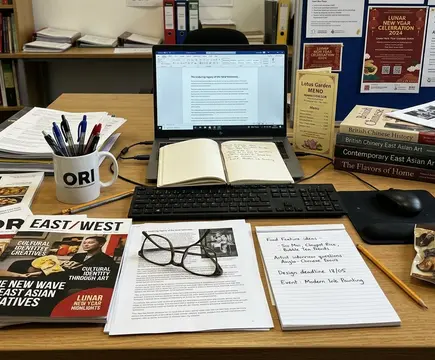
Poetry collections and essay anthologies address race, language and representation through shorter forms that capture fragmented, in-between identities. Anthologies gather multiple emerging British East Asian voices, compiling works from 10 to 15 distinct contributors, based on typical anthology ranges, written over a 24 to 36-month period.
Where to Start and How to Read Wider
An entry point follows the reader's existing habits: fiction lovers may begin with the novels, while non-fiction readers can open with the memoirs. At a practical reading pace, one title every 3 to 4 weeks allows absorption of the cultural nuances. Cross-referencing with catalogues from independent, East Asian-focused publishers widens the view. Relying solely on independent bookshops for these specific titles may require ordering 10 to 14 days in advance, as smaller print runs often mean they are not held in standard inventory. Together the books build a fuller picture of British Chinese life than any single story can.










Share Your Opinion