
A Single Cut Beside the Jinjiang
The Red Yao women of Huangluo village, in Longsheng County, Guangxi, cut their hair once. The ceremonial cut comes at about eighteen, the passage into adulthood, and the decades after are given to continuous growth.
What carries the village into view is a river scene. Women wash floor-length hair in the Jinjiang, then lift the wet mass and coil it onto the crown. Those coils are not a single repeated shape. Three distinct crown styles indicate marital and maternal status, so the head holds a public record of a life as well as the weight of the hair itself.
Woven Back into the Updo
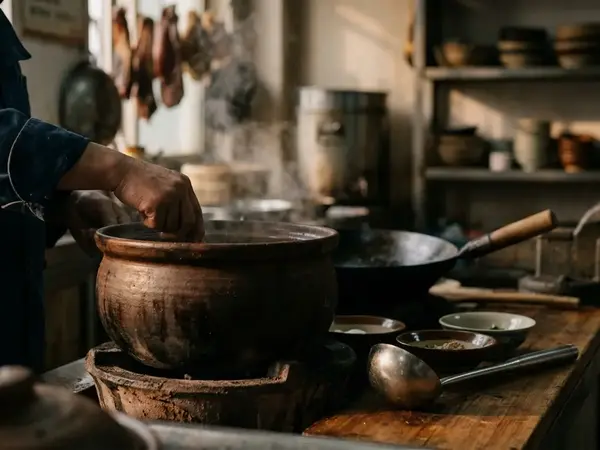
The washing liquid belongs to the kitchen, not to a separate beauty shelf. Rice water left from cooking is fermented in a jar and often boiled with pomelo peel before it meets the scalp. Starch, acid and citrus peel are the whole formula.
Shed hair stays inside the practice. Strands that fall, and strands that are trimmed, are gathered into a woven bundle and braided back into the daily updo. Growth and loss remain on the same head. For a British Chinese kitchen working from one bag of rice, that is the structural point worth keeping: the rinse continues the hair's own life, drawn from the household pot.
Starch in the Water, Acid in the Jar
Draw a wet length between finger and thumb after a wash in hard British water. Slip, then a dull catch. The Yao rinse begins from a plainer material than any salon gloss: uncooked rice, covered and agitated until the water clouds.
Soaking pulls surface starch, inositol, B vitamins and trace amino acids out of the grain and into that cloud. On the shaft they sit as a light coat. Slip improves. Body improves. The coat is physical, a film of what the grain releases in cold water, and it asks for no silicone to feel present under the hand.
Fermentation is the second movement, and it works by acid. Natural yeasts and bacteria sour the jar. Across 24 to 48 hours the liquid shifts from neutral toward a mildly acidic state, into the neighbourhood of the hair's weakly acidic mantle. Raised cuticle scales have less reason to stand proud. They lie flatter. A flatter cuticle returns light along one plane, which is why soured rice water can read as shine.
Green tea enters as a third layer, with a job of its own. Catechins and other polyphenols bring an antioxidant fraction and a mild astringency on the scalp. The infusion also softens the sour smell of the ferment, which matters in a small flat where the jar and the shower share a room. Starch gives the coat. Acid settles the cuticle. Tea makes the scalp willing to meet that coat often enough for the coat to matter.
Cold Water, Thirty Minutes, Then the Wait
Must the rice be boiled before it will give up its starch?
I put a pot of rice into excess water, drained the thick gruel, and cooled it. In the fridge the starch congealed into a heavy paste. On fine hair it dried as a dull, flaky film. A cold soak took the place of that route, and the grains survived it.
Half a cup of uncooked rice, 100g, meets two cups of cooled boiled water, 475ml. White jasmine or plain long grain both serve. Organic grain is the cleaner start when the shop has it. A quick first rinse lifts surface dust, and that water is discarded. The second water is the extraction: about 30 minutes of swirling and squeezing, kneading the grains until the liquid turns milky. A fine sieve or a piece of muslin strains it. The damp grains go to the steamer for dinner.
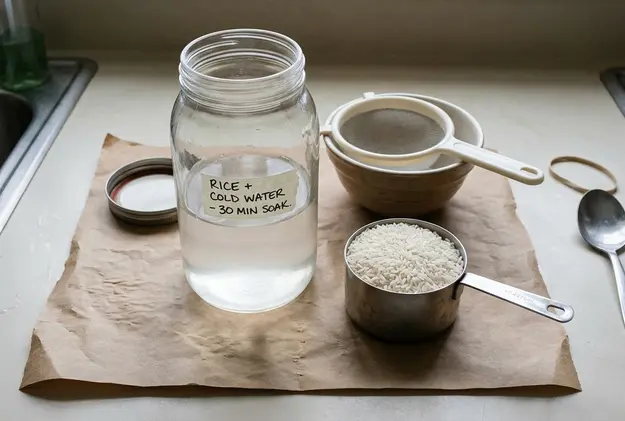
The milky water goes into a clean glass jar. A loose muslin cloth and a rubber band keep dust off without sealing the ferment shut. On a 21°C summer worktop the souring takes 24 to 36 hours. On a 16°C British winter worktop it wants 36 to 48 hours. Tiny bubbles at the surface and a clean lactic tang mark the inside of that window.
Past Forty-Eight HoursUnsealed jars left past 48 hours in a warm UK kitchen cross from pleasant lacto-fermentation into putrid spoilage. Pour the jar away. Watering it down will not bring it back inside the window.
An optional five-minute simmer with dried pomelo peel, or unwaxed orange peel when pomelo is scarce at the grocer, ties the home jar to the Huangluo pot. Cool the liquid fully before it is stored or blended with tea.
Order on the Worktop
- Rinse 100g uncooked white rice briefly to clear surface dust, then discard the first water.
- Soak the rinsed grains in 475ml cooled boiled water for 30 minutes, kneading until the liquid is opaque and milky.
- Strain through a fine sieve or muslin. Keep the damp grains for the steamer.
- Ferment 24 to 36 hours at about 21°C, or 36 to 48 hours at about 16°C, cloth-covered, not sealed tight.
- If you want the citrus note, simmer five minutes with dried pomelo or unwaxed orange peel, then cool again.
Longjing Cooled Before It Meets the Ferment
The tea never meets the ferment while either is hot. A concentrated green infusion, brewed apart and cooled, leaves the rice starch uncooked and takes the sharp vinegary edge off the soured jar.
Cool the Cup FirstHeat would cook the starch the cold soak worked to keep fluid. The cup has to reach room temperature before it joins the jar.
Two standard green tea bags, or 5g of loose sencha or Longjing, go into 240ml of water at roughly 80°C. Three to five minutes of steeping is enough. Twenty to thirty minutes on the counter brings the cup down to room temperature. Only then does it meet the rice water.
The fermented base is strong. Dilute at one part ferment to two or three parts of the combined tea and plain water, and pour the mix into a nozzle squeeze bottle or a jug that will stand on the shower ledge. The bottle should look like weak milky tea, well short of the opacity of the undiluted jar.
Refrigerate the finished blend at 4°C. Five to seven days is the outside limit. A clean sour smell can stay. A rotten or harshly yeasty smell means the bottle is finished. A scrap of tape with the date is a better clock than memory, especially in a week when the jar is easy to forget at the back of the shelf.
Longjing and sencha differ in the cup, though both supply the catechin fraction this rinse is after. Pan-fired Longjing sits quietly beside the rice. Sencha is grassier and will announce itself in the steam of a small bathroom. Choose by what you already drink with a weekday meal. The hair receives polyphenols and a mild astringency either way. The kitchen receives a tea you can finish while the jar works.
When a Wet Strand Snaps
Pull a wet strand from the nape and stretch it. A dry, straw-like snap is the early sign that starch and amino acids have piled up on the shaft. Stiff ends follow. So does a stubborn tangle in that same nape zone, where rinse tends to sit and a mild shampoo tends to miss.
The coat that gives slip in the first week becomes a crust when it accumulates faster than ordinary shampoo can lift it. Hair that is already rich in protein, or dense with styling residue, reaches that crust sooner. Spacing the rinses, or adding more water to the bottle, is the correction. A clarifying wash on the week you pause clears the film, so the next ferment can lie on a clean shaft.
Low-porosity, fine, or protein-sensitive hair absorbs and retains surface starch rapidly, so weekly applications turn brittle and straw-like unless the ferment is diluted to a 1:4 ratio or spaced to once a month.
Before the first scalp contact, patch-test if you live with eczema, a sensitive scalp, or a known rice allergy. A dab behind the ear or on the inner forearm, left for 24 hours, is the check. Keep the ferment off broken or openly irritated scalp skin. The acid that flatters a closed cuticle is a poor match for a raw patch.
Straw-Snap SignalIf stiffness appears on hair that had been taking a weekly rhythm, widen the gap to every 14 to 21 days. The strand is reporting deposition. Pause before the snap becomes a break.
Cap On, While the Shower Finishes
How much of a thin, cloudy liquid actually stays on the hair once the shower is running?
Almost none, if the lengths are still streaming with tap water. The acidic tea-and-rice mix needs contact with the cuticle, not a straight path to the drain. Shampoo as usual. Squeeze out the excess. Towel-blot until the hair is wet and no longer pouring, so the rinse meets the shaft at the strength you mixed.
Crown to Tips
- Measure 150ml to 250ml of lukewarm diluted rinse and pour slowly from the crown to the tips.
- With fingertips, work it into the scalp for one to two minutes. Nails stay out of it.
- Twist the hair into a loose coil, or clip it, and cover it with a reusable shower cap.
- Leave the cap on for 10 to 20 minutes while the rest of the wash finishes.
- Rinse, then pass a wide-tooth comb through the lengths so a softened cuticle is separated, not raked.
Once every seven days is the rhythm this dilution is built for, when the strand from the week before still stretched and sprang back. Hair that has already signalled overload belongs on the wider gap, not on a stricter schedule.
The measure that starts the week is modest, and it does double duty in the kitchen. Cold-soaking 100g of uncooked rice for 30 minutes extracts surface starch and inositol while the raw grains stay intact for that evening's steamer pot.










Share Your Opinion