

Table of Contents
- Surplus Eggs, Salt, and the Route to Britain
- Duck Eggs That Will Take a Cure
- Wet Brine Against a Salt Crust in a Small Kitchen
- How I Build the Saturated Jar
- When the Yolk Turns Firm and Oily
- What a British Shelf Will and Will Not Forgive
- The Bowl I Make When the First Egg Opens
Surplus Eggs, Salt, and the Route to Britain
I start from a material fact. Surplus duck eggs from paddy-field flocks in the Yangtze delta had to last through months without refrigeration, so families packed them in salt or mud.
That packing is the whole theory in miniature. Salt pulls water from the white, slows the organisms that would sour a fresh egg, and slowly concentrates the fat in the yolk until the centre grains.
Gaoyou in Jiangsu became the name most associated with the double-yolked, oil-heavy salted egg. The restaurant plate came later. The jar came first.
The technique travelled south through Guangdong and Fujian and then outward with migration. I read that passage as a restaging. The Orphan of Zhao reached British stages through successive retellings; the salted egg reached British groceries by being packed, shipped, and sold already cured.
Hong Kong and Cantonese migration from the 1950s to 1970s built the grocery networks that still stock them. Most UK readers first met one grated over congee or buried in a mooncake. The Chinatown chiller cabinet arrived before the home jar ever did.
Putting the egg back into a jar on a British shelf returns the food to its first principle: salt, time, and a membrane strong enough to hold both.
Duck Eggs That Will Take a Cure
Why insist on duck eggs when hen eggs sit in every fridge?
The duck egg carries a thicker shell membrane and a larger, fattier yolk. That yolk is the structural reason for the cure. Fat and a tight membrane are what let the centre grain and bead oil under pressure. Hen eggs accept salt, then set rubbery and pale beside a duck yolk that has done the same weeks in brine.
Where the Cartons Turn Up
In the UK I look first in Asian supermarkets in Chinatown districts and in out-of-town Chinese and Vietnamese grocers. Turkish and Polish shops often carry duck eggs too. Farmers' markets, farm-gate honesty boxes, and British producers on larger supermarket shelves fill the gaps when Chinatown is a train ride away.
Freshness Before Size
A very fresh egg holds a tight membrane and cures evenly. Size is secondary. I float-test every egg before I commit a whole jar, and I reject any egg that tilts upright or bobs.
Older eggs lose membrane integrity too far for an even cure, whether they come out of a supermarket carton or a farm-gate box.
I work in twelves. Twelve eggs make a standard batch and leave room for sacrificial tests on days 21, 28, and 35.
Skip The Bobbers
Any egg that stands on end or rides high in a bowl of water is already too old for an even cure. Cook it for breakfast. Keep it out of the jar.
Wet Brine Against a Salt Crust in a Small Kitchen
Picture twelve eggs, each rolled in Shaoxing wine, packed in a coarse salt paste, and wrapped. That is the salt-crust method as it arrives from a Guangdong counter. It gives a drier white and a faster yolk set. It also covers a worktop and asks for shelf I do not have in a rented flat.
Wet brine is saturated salt water in a single jar. It is cheap, forgiving, and easy to scale down to six eggs. A 1 to 2 litre glass jar holds a half or full dozen. A larder sitting between 12°C and 18°C keeps the cure inside its best window.
Storage footprint, the saltiness of the white, and the ease of checking progress without unwrapping everything: those three decide the method in a UK kitchen. Wet brine occupies one jar. I can lift an egg, candle it, and put it back. The crust still belongs in a house with a pantry and a taste for a drier white. In a small kitchen I leave the paste in the memory of other rooms and fill the jar instead.
How I Build the Saturated Jar
The jar is a closed system of salt, water, and shell. Get the saturation and the temperature right, and the rest is waiting.
What Goes On the Counter
Active preparation takes 10 to 12 minutes once the brine has cooled. I lay out the same kit every time.
- 1 to 2 litre glass jar with a tight-sealing lid, sterilised and fully cooled
- 12 fresh duck eggs, left unwashed until immediately before curing
- Non-iodized coarse sea salt or rock salt, enough to reach saturation
- A saucepan, kitchen paper, and a small plate or a clean ziplock bag of water to act as a weight
Salt Water, Then Silence
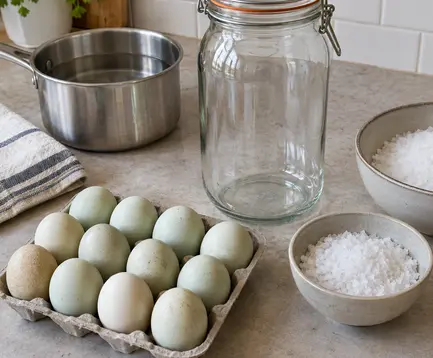
I sterilise the jar in a hot oven or a dishwasher cycle and let it cool fully. Brine poured into a hot jar can crack an egg on contact.
Water goes to 100°C. I stir in salt until no more dissolves and a few grains sit stubbornly on the base. That brine cools completely to 20°C before it meets the eggs. Thermal shock is a dull way to lose a dozen.
Eggs float in saturated brine. A 15mm to 20mm patch of shell sits above the surface unless I weight them. A small plate, or a clean bag of water, holds them under so the cure meets every face of the shell.
Weight The Floaters
An unweighted egg leaves a dry patch of shell. That patch takes salt slower than the rest and breaks the even set you are waiting for.
When the Yolk Turns Firm and Oily
When has the yolk actually turned?
Treat dates as a guide. In a cool UK room the window sits around four weeks, 28 to 35 days of total curing time, stretching toward 28 to 42 days when winter drops the larder temperature, shortening if the kitchen runs warm. The test egg decides. Calendars do not.
A Torch, Then a Pan
Candling against a phone torch, a cured yolk reads as a dense dark sphere that barely moves when I rock the egg. Liquid yolk still sloshes. Firm yolk sits.
The definitive test is destructive. I boil one egg for 12 minutes, cool it, peel it, and halve it. The yolk should be deep orange to vermilion, firm at the edge, slightly grainy, and should bead oil when pressed. I schedule that first boiled egg at day 28 to gauge salinity, with further tests at day 21 and day 35 if the cut face still slumps.
Halve The Tester
Colour, grain, and a bead of oil on the cut face tell you more than any marked date. If the yolk still slumps, the jar goes back on the shelf.
What a British Shelf Will and Will Not Forgive
A jar that smells clean on Monday can turn on Wednesday. If the brine goes cloudy, ropy, or sour, I discard the whole batch within 24 to 48 hours. I do the same for any egg that cracks in the jar, and for any fuzzy growth at the surface.
There is no rescue path I trust. Tasting your way out of a compromised brine is a bad theory of risk.
This is a salt cure. The brine suppresses spoilage organisms; the egg inside stays raw until I cook it. I cook salted duck eggs through before eating.
The home-curing parameters here assume the final egg will be eaten by healthy adults and cooked thoroughly. Anyone pregnant, very young, elderly, or immunocompromised should follow current national advice on eggs rather than this kitchen method. I point to Food Standards Agency guidance on eggs for that scope.
Ropy Brine Goes
Cloudiness, a slick thread between spoon and surface, or a sour smell ends the batch. Tip it away. Wash the jar. Begin again with fresh eggs.
The Bowl I Make When the First Egg Opens
I build the first bowl thin. Rice congee, a halved salted egg with the yolk chopped through, spring onion dressed with white rice vinegar, and a spoon of the oily yolk crumb stirred in at the table.

As a seasoning element I work to roughly a quarter of an egg per serving, so the salt reads against unseasoned rice rather than shouting over it. Quiet, oily, exact—that is the balance I want on the first morning.
The same batch earns space in a steamed minced pork patty, in salted egg yolk folded into butter for prawns or chips, and as quartered yolks in rice dumplings. One jar feeds several tables if you treat the yolk as seasoning rather than as a whole course.
Start with the wet brine. Twelve eggs. Saturated salt. A weight on top. A test egg at week four. I stand behind that method because it is self-correcting, it costs less than a single tub of imported cured eggs, and it lets me crack one open early without dismantling the batch. Tomorrow I would fill the jar again the same way.















Share Your Opinion