
Table of Contents
- The Takeaway Counter and the Weeping Mother
- What a Development Note Really Means by 'Raise the Stakes'
- What the Booking Calls Taught Me About Who Actually Turns Up
- Six Films Nobody Has Financed Yet
- This Is an Argument for Range, Not Against Remembering
- The Year the Prize Went to a Kung Fu Multiverse Comedy
The Takeaway Counter and the Weeping Mother
Po-Chih Leong's Ping Pong reached British cinemas in 1986 as the first feature built around Britain's Chinese community. It walked into a social-realist filmmaking culture that treated hardship as the proof of authenticity.
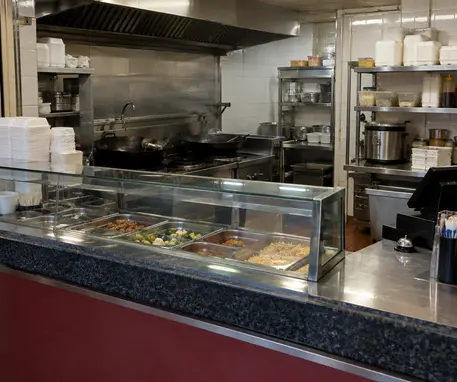
I treat that kitchen as structure. A community asked to justify its presence on British screens reaches first for pain, because pain is the available evidence. British stages already know how to receive The Orphan of Zhao: a revenge cycle that completes itself through sacrifice. Screen development has been running a quieter version of the same reception theory.
The 1990s and 2000s assembled a British Asian screen vocabulary around migration, racism and honour plots. East Asian stories were pressed into that groove. Ping Pong should have opened a field. It furnished a template instead, and the weeping mother remains the cheapest way to signal that a British Chinese life has weight.
What a Development Note Really Means by 'Raise the Stakes'
Cultural specificity gets coded as suffering the moment a script enters a public funding application. A draft that explains itself through struggle reads as important. A draft that withholds that explanation reads as slight.
Writers learn the code across a script development cycle of roughly 12 to 18 months. The note recurs with dull reliability: more conflict with the parents, more racism on screen, a death in act three. Third-act tragedies appear during late-stage revision rounds. Many writers now pre-load the trauma before page one, a calculated move to keep the project inside the round.
Pre-Loaded Third Act
If the death, the honour quarrel and the racist incident are already in the outline, ask which of them the story actually needs. Stakes can be a ruined service, a bad diagnosis, a lost match. Pain imported to look fundable will still show on camera as imported pain.
Trauma functions as the visa. Without it, an East Asian British script struggles to look serious enough for a public round. I have watched that bargain sit beside documents such as the BFI's Diversity Standards. Inclusion paperwork can widen who is in the room. It does not, on its own, change what a reader hears as dramatic pressure.
What the Booking Calls Taught Me About Who Actually Turns Up
Who actually turns up on a Friday?
I have listened to independent UK booking calls long enough to hear the split in the room. The trauma-led title lands the festival slot and the panel discussion. Then it plays two independent screens. The theatrical run lasts 10 to 14 days. Programmers place heavy East Asian diaspora titles into education strands and heritage months, and the film becomes curriculum.
British Chinese and East Asian audiences buy tickets for comedy, romance and genre. They buy anything a group of friends can attend without bracing for a lecture on their own lives. That is a distribution fact before it is a taste argument.
Friday Without Bracing
If the booking call only works in a heritage month, the film has been filed as teaching aid. Ask whether a table of cousins would choose it after work. If the answer is a wince, the commercial problem and the aesthetic problem are the same problem.
Two screens and a fortnight will not build a star system. A Friday comedy might, because people return to pleasure.
Six Films Nobody Has Financed Yet
Across pitching windows in the past few years, six distinct genre scripts have sat on desks and gone nowhere. The editorial test was blunt: everyday forms that refuse to open with a history lesson.
- A Manchester rom-com whose obstacle is a bad haircut and a worse text message.
- A workplace comedy inside a Cantonese-speaking dental practice in Birmingham.
- A heist picture whose crew happens to be four cousins from Croydon.
- A Glasgow badminton drama that treats the smash as the plot.
- A Sheffield indie-band picture about a drummer who cannot keep time.
- A Brighton weekend farce driven by a family WhatsApp group and a ruined hen do.
Ordinary joy is the missing commissioning category. Workplace comedy and sports drama sit in that gap with the Croydon heist and the Glasgow court. None of these require a character to explain China, Hong Kong or Malaysia to a presumed outsider. That refusal is the design.
This Is an Argument for Range, Not Against Remembering
Keep the Windrush-era pictures, the Hong Kong handover dramas and the wartime stories in production. The archive of diaspora hardship deserves better money, sharper craft, and a longer theatrical life than two screens can give it.
One film about grief remains a film. Twenty in a row becomes a casting brief. Trauma written by choice lands with a different grain from trauma written to satisfy a criterion, and audiences can hear the difference in the pacing.
I am confining this account to UK public funding bodies and independent distribution networks; commissioning inside global streaming platforms, and inside film industries in East Asia, sits outside the claim. Funding cycles over recent years kept returning to historical hardship archives. Range would mean letting a badminton smash carry a second act, and grading the release on craft, pace and performance.
Grade The Craft
Duty is a poor critic. If the scene works because the timing works, fund the next one in that key. Memory still has a place on the slate. It cannot be the whole slate.
The Year the Prize Went to a Kung Fu Multiverse Comedy
Producers and writers can push back on the pain note by pitching absurdity and genre play, and they now have an international result to drop on the table. UK funding rounds typically run six to nine months and have long treated comedy as unserious. Ask what the film would be if the answer to more pain were no.
In early 2023 Michelle Yeoh became the first Asian woman to win the Academy Award for Best Actress, collecting it for a chaotic kung fu multiverse comedy stuffed with laundromat tax receipts, googly eyes and hot dog fingers.










Share Your Opinion