
Why Cantonese Cooking Rewards the Home Cook
Cantonese cuisine prizes freshness, balance and technique over heavy seasoning. When planning this guide, we decided to focus on foundational techniques rather than an exhaustive recipe list to prevent overwhelming beginners. A standard dim sum session requires roughly two to three hours of active prep time.
Focusing on three core signature dishes—char siu, cheung fun and the char siu bun, makes the process achievable for a weekend project. This guide draws directly on the chefs and classes featured in our magazine, including Royal China and London dim sum instruction. The goal is not to replicate a banquet, but to understand the mechanics of the kitchen.
Essential Kit and Pantry Staples
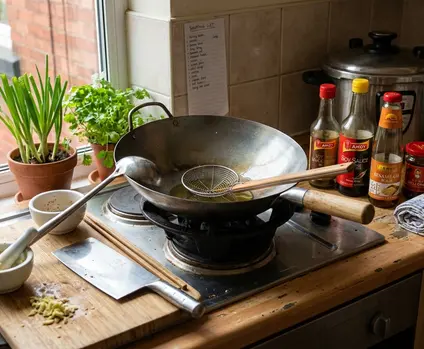
A carbon-steel wok and a tiered bamboo steamer are the two basic tools you need on your counter. We initially considered recommending non-stick pans for accessibility, but ruled them out because they cannot safely reach the temperatures required for authentic wok hei.
According to published benchmarks, a proper carbon-steel wok requires initial seasoning at 200°C to 230°C to build its natural patina. For standard home hobs, 10-inch to 12-inch bamboo steamers fit well over a water bath. Building a core pantry of five to seven essential sauces opens up much of the cuisine. You do not need a sprawling spice rack, just a few high-quality liquids.
Cantonese Starter Pantry & Kit Checklist
- 14-inch carbon-steel wok, round or flat-bottom depending on hob
- 10-inch bamboo steamer with at least two tiers
- Light soy sauce for seasoning and dark soy sauce for colour
- Shaoxing rice wine, minimum 3 years aged
- Oyster sauce, sesame oil, and ground white pepper
- Maltose or honey for basting
- Bleached white flour for bun dough
Char Siu: Cantonese Roast BBQ Pork
What builds the glossy, lacquered finish of authentic char siu? It comes down to a sweet-savoury marinade and methodical heat application. Billy Wong, Head Chef at Royal China, highlights basting as the technique that builds this finish.
The decision to emphasize staged basting came directly from observing professional roasting lines where layering builds the lacquer. Marinate pork shoulder for 24 to 36 hours, a standard window in many Cantonese roast pork recipes, to let the flavours settle.
Expert Tip: Marinade absorption rates vary significantly depending on whether you use pork belly, which requires longer penetration time, or pork neck, which tenderizes faster.
Roast the meat near 220°C to render the fat, before dropping the oven closer to 180°C for the final glaze. The sugar in the maltose needs careful watching to prevent burning.
Dim Sum at Home: Buns, Rice Rolls and the Art of the Dough
A proper char siu bun should have a marshmallow-soft texture and a cracked, opened top when steamed. We chose to highlight the kneading process over yeast selection, as gluten development dictates the final texture.
Kneading dough for 12 to 15 minutes until smooth gives you the best chance of success. Resting periods of 45 to 60 minutes follow, depending on ambient kitchen temperature. Bleached white flour gives the classic bright white finish you see in bamboo baskets across Chinatown. Cheung fun are steamed rice wraps, often with a crispy roll folded inside to provide a textural contrast.
Core Techniques: Steaming and the Wok Toss
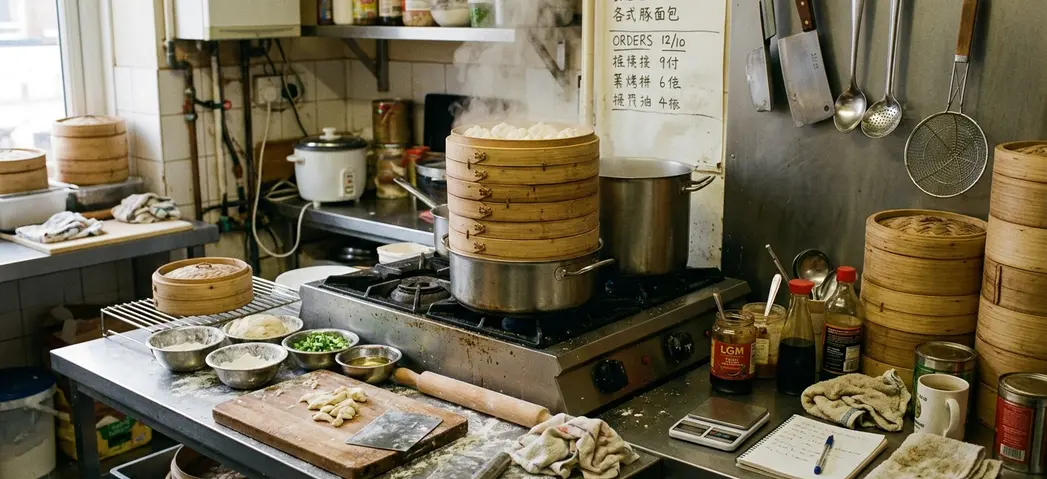
We structured this section to separate steaming and wok tossing, treating them as distinct disciplines requiring different heat management strategies. Steaming preserves freshness and demands a steady hand. Maintain a rolling boil that generates steam near 100°C.
Caution: Overcrowding a 10-inch bamboo steamer causes a temperature drop, resulting in gummy, undercooked bun dough rather than a fluffy texture.
The wok toss, a technique taught at London's School of Wok, keeps ingredients moving for even heat. Cook stir-fry batches of 200g to 250g to maintain wok temperature and prevent the meat from stewing in its own juices.
What You Can Realistically Achieve at Home
Can a home kitchen truly replicate a bustling Chinatown service? Restaurant results rely on commercial heat, dedicated ovens and years of repetition. Even Gordon Ramsay's televised dim sum attempt at the Royal China Club showed how exacting the discipline is.
We included a reality check on home equipment to manage expectations regarding commercial-grade caramelisation. From commonly referenced data, standard home hobs output 7,000 to 12,000 BTUs. Commercial wok burners can run upwards of 100,000 BTUs.
Home cooks often find that achieving the signature cracked top on a char siu bun requires a rapid, aggressive steam expansion that many standard home setups struggle to produce consistently. Bleached white flour and certain additives are traditional choices, not strict requirements. Substitutions work fine for everyday meals.
Where to Learn Hands-On
Classes offer feedback you cannot get from a recipe alone. We prioritized hands-on community classes over online video tutorials because tactile feedback is crucial for dough work.
Kevin Lam runs dim sum classes at the London Chinese Community Centre, an institution whose operations date back to 1980. Masterclasses typically run for about two and a half to four hours. The School of Wok also teaches wok toss and dim sum courses.
Mastering these folds and tosses requires the kind of generational repetition seen in classical arts. Much like the enduring performances of The Orphan of Zhao, the technique is passed down through rigorous, physical practice rather than mere observation.
Bringing It All Together
Master steaming and basting first. They unlock the widest range of dishes in the Cantonese repertoire. The next step is to focus on one dish before expanding the repertoire.
Dedicating three to four weekends to perfecting a single technique can help build confidence. Invest in a wok and steamer before anything else.
Main Point: Build a small, reliable pantry and cook one dish repeatedly to learn it properly.











Share Your Opinion