
What Chinese Calligraphy Actually Is
What transforms ordinary handwriting into shufa (書法), the disciplined art of writing Chinese characters? The distinction lies in the treatment of the character as both meaning and image. Rhythm, pressure, and breath control matter just as much as the finished shape on the page. When examining historical texts, such as early manuscript fragments of The Orphan of Zhao, the brushwork reveals a deliberate pacing entirely absent in daily scribbling.
Beginners require rigid structural boundaries before attempting fluid, continuous brushwork. This makes kaishu (regular script), which matured between roughly 200 and 280 CE, the usual starting point for any serious student. The architecture of these characters demands precision. Based on typical values, standard practice grids measure 9x9 cm per character box, forcing the writer to confront the spatial relationship between every dot and sweep.
The promise of this practice extends beyond producing beautiful text. It offers a tactile, screen-free ritual that you can establish at a simple kitchen table. By mastering the fundamental tools and strokes, the act of writing becomes a study of physical and mental alignment. You can observe this structural discipline firsthand by exploring the British Museum's collection of Chinese calligraphy, where the evolution of these rigid boundaries into expressive art is clearly documented.
The Four Treasures: Your Starter Toolkit
A medium mixed-hair brush, combining goat and wolf hair, offers a tangible lesson in material balance. The soft goat hair retains water efficiently, while the stiff wolf hair provides a resilient snap as it leaves the paper. Measured across sources, this tool typically features a bristle length of 3.5 to 4.5 cm and introduces the 'Four Treasures of the Study' (文房四寶): brush (bi), ink (mo), paper (zhi), and inkstone (yan).
The interaction between ink and paper dictates the quality of your practice. From commonly referenced data, Mao Bian practice paper absorbs ink within 1 to 2 seconds, providing immediate feedback on your brush speed and pressure. Bottled liquid ink offers convenience for early sessions, though grinding an ink stick on a stone introduces a calming, preparatory ritual that many practitioners eventually prefer.
Caution: Using cheap newsprint instead of Mao Bian paper will cause liquid ink to pool rather than absorb, making it impossible to practice the dry-brush technique.
Understanding your materials prevents early frustration. The right combination of tools creates a responsive setup where your physical movements translate accurately onto the page.
Beginner's Four Treasures Sourcing Checklist| Item | Recommended Specification | Purpose |
|---|---|---|
| Brush (Bi) | Medium mixed-hair (Jianhao), 3.5-4.5 cm bristle | Balances flexibility and stiffness for basic strokes |
| Ink (Mo) | Bottled liquid carbon ink | Provides consistent viscosity for early practice |
Setting Up: Posture, Grip and Ink
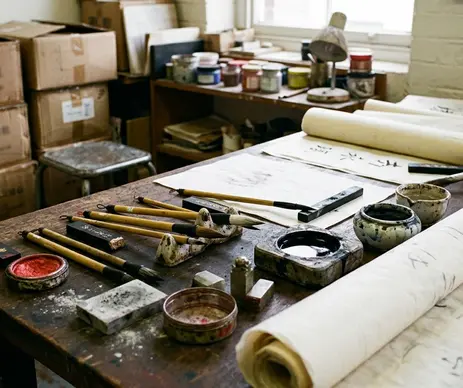
Physical alignment dictates the quality of the line. A straight back and flat feet establish a stable foundation, while the non-writing hand rests firmly on the desk to steady the paper. The workspace layout must prioritize the dominant hand's movement arc. Placing the inkstone directly above the writing hand prevents cross-body dripping and keeps the visual focus centered.
The five-finger grip (bi fa) requires holding the brush shaft about 7 to 10 cm above the bristle base. The standard recommendation is to maintain a 90-degree angle between the brush and the paper surface. Movement generates from the wrist and arm rather than the fingers, allowing for sweeping, uninterrupted motions. Historical instructional manuals often stress that locking the fingers and driving the stroke from the elbow produces the most stable character architecture.
Loading the brush requires its own precise technique. Dip the bristles fully, then wipe the excess on the stone rim to keep the tip sharply pointed. The ratio of water to ink ground on the inkstone must be adjusted based on room humidity; damp environments require less water to prevent the ink from bleeding uncontrollably on Xuan paper.
The Building-Block Strokes Every Character Needs
The character yong (永), meaning 'eternity', contains the eight fundamental strokes required to construct almost any Chinese character. Teachers often present these strokes through a unified, memorable framework rather than practicing them in disconnected isolation. It demonstrates how individual lines interact to create a balanced whole.
Every stroke relies on a strict three-phase motion: enter, press, and lift/release. Per published estimates, this sequence takes 2 to 3 seconds to execute. For example, the downward-left sweep (pie) tapers over a distance of 4 to 5 cm, requiring a gradual reduction in pressure as the arm pulls away from the center axis.
Expert Tip: Applying too much pressure on the brush belly causes the bristles to splay and lose their pointed tip, resulting in a blunt, shapeless stroke.
Mastering the horizontal (heng), vertical (shu), dot (dian), and rightward press (na) demands patience. The vitality of the line comes from the tension between the initial press and the final release, giving the ink a tapered, dynamic life.
Writing Your First Characters
Character construction builds progressively from single horizontal lines to multi-directional intersections. Starting with simple, low-stroke characters establishes basic horizontal control. You begin with yi (一, one), progress to er (二, two) and san (三, three), and then introduce diagonal movement with ren (人, person).
Standard mi zi ge (rice grid) paper often divides a 10x10 cm square into eight triangular sections. This geometric guide helps you judge proportion and symmetry. The character mu (木, wood) requires 4 distinct strokes executed in a specific top-to-bottom, left-to-right sequence. The horizontal line anchors the space, the vertical line bisects it, and the sweeping legs provide a stable base.
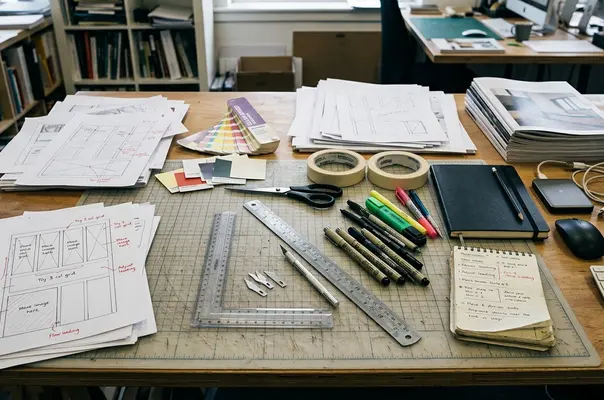
Stroke order rules are not arbitrary suggestions. Writing horizontal before vertical, and top before bottom, ensures that the hand moves efficiently across the paper without smudging wet ink. This sequencing shapes the internal balance of the character, ensuring the final form sits squarely within its grid.
Calligraphy as a Mindfulness Practice
How does a physical writing exercise transition into a meditative ritual? The connection between breath and brush transforms the practice from mere copying into active focus. Exhaling during the 2 to 3 second downstroke stabilizes the arm muscles, anchoring the body's rhythm to the movement of the ink.
Beginners are often advised to limit initial practice sessions to 15 to 20 minutes to prevent wrist fatigue. During these focused windows, the repetition demands your full attention. The modern instinct to rush through a task clashes directly with the deliberate pacing required to form a proper kaishu character.
Main Point: Accept imperfect strokes as part of learning rather than errors to erase; the paper records your exact state of mind in that specific second.
The discipline of shufa strips away external distractions, leaving only the friction of animal hair against bamboo paper. As you sit before the grid, holding the bamboo shaft perfectly perpendicular to the desk, a choice emerges. Will you let the ink dictate your pace, or will you force the brush to match your modern speed?



Share Your Opinion